



Living with back pain that doesn’t seem to go away can feel frustrating, and for many people the reason is something called Degenerative Disc Disease (DDD). It’s more common than most realize — studies in India [1] [2] show that disc changes are seen in a large number of adults, even those who don’t have obvious symptoms. Over time, these changes can lead to stiffness, pain that radiates into the arms or legs, and difficulty with everyday movements [3]. With desk jobs, long commutes, and less active lifestyles becoming the norm, the number of people experiencing DDD is steadily rising. That’s why spinal physiotherapy and structured physical therapy for degenerative disc disease in India are gaining importance as safe, effective ways to manage the condition without surgery.
At ReLiva Physiotherapy & Rehab, our physiotherapists meet patients with DDD every day. They understand how the condition creeps up slowly and how it impacts daily life—from sitting at a desk to bending down for simple chores. Drawing on years of clinical experience, ReLiva’s team specializes in spinal physiotherapy for spine conditions, helping people reduce pain, improve flexibility, and overall muscular strength with customised treatment protocols to get back to the activities they enjoy. In this article, our experts share their insights on causing Degenerative Disc Disease (that may accelerate spinal arthritis)and how physiotherapy can make a real difference.
Understanding Degenerative Disc Disease
Degenerative Disc Disease occurs when the discs between the vertebrae naturally lose hydration and elasticity over time. These discs act as natural cushions that help distribute pressure and allow smooth movement. When they begin to dry out or collapse, the spine becomes stiff and movements such as bending, twisting, lifting, or even prolonged sitting can trigger pain.
People living with DDD often notice their symptoms creeping up slowly. It may begin as mild discomfort that comes and goes, but with time, the pain becomes more persistent. Many individuals describe stiffness after waking up, increased discomfort after long hours at a desk, or pain radiating through the arms or legs because of nerve irritation. Some experience tightness across the back or neck because the surrounding muscles work overtime to support the weakened discs. Daily flexibility also gradually reduces, making routine activities feel more tedious than they should.
Causes and Risk Factors of Degenerative Disc Disease
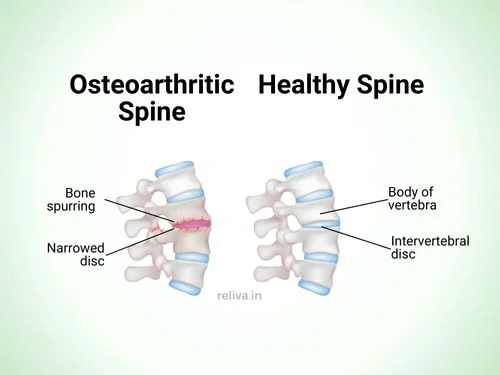
Several factors contribute to disc degeneration, including:
- Age-related degeneration – natural loss of disc hydration and elasticity
- Repetitive strain from prolonged sitting, lifting, or bending
- Poor posture, especially during desk work or screen use
- Sedentary lifestyle leading to weak core and spinal muscles
- Genetic predisposition
- Previous spinal injuries or trauma
- Infectious disease of spine like TB spine.
These factors often work together, gradually increasing stress on the spine and accelerating disc degeneration.
Signs You Need Physiotherapy for DDD (Non-Surgical Disc Treatment)
Physiotherapy is often recommended as the first line of treatment for degenerative disc disease. You should consider spinal physiotherapy treatment if you experience:
- Persistent or worsening back or neck pain
- Reduced flexibility or stiffness affecting movement
- Difficulty performing daily activities like sitting, walking, or bending
- Pain that interferes with work, sleep, or quality of life
Physiotherapy offers a safe, evidence-based, non-surgical disc treatment approach focused on pain relief, movement restoration, and long-term spine health.
Early intervention with physiotherapy can prevent further deterioration and reduce dependency on medications or surgery.

How Physiotherapy Helps Degenerative Disc Disease
Many people report that they feel significantly better within a few weeks of starting physiotherapy. This is because physiotherapy does not just treat the pain; it addresses the deeper root causes, such as weak spinal muscles, restricted mobility, poor posture, and disc-generated inflammation.
Deepak Gadakh with spinal disc bulge, is a case in point. He visited Dr. Khyati (PT) at ReLiva Physiotherapy in Thane. He remarks, “the improvement I’ve seen is real, not just temporary relief.” He is particularly appreciative about the treatment approach – “She is extremely knowledgeable and, more importantly, actually listens. Her treatment plan was practical, targeted, and focused on long-term recovery, not shortcuts. What really stands out is her care and attention. She monitors progress closely, corrects posture and exercises patiently, and makes sure you’re doing things the right way, not just ticking boxes.” He presents ReLiva as highly recommended for spine physiotherapy to all those dealing with disc issues and want someone who is professional, caring, and genuinely invested in your recovery. “ReLiva is absolutely worth trusting.”
Your spine health deserves professional attention. Take the first step toward recovery today with ReLiva’s personalized spinal physiotherapy programs
Is Degenerative Disc Disease a serious condition?
It is important to understand that many people will live active and sometimes pain-free lives with Degenerative Disc Disease-this is indeed a disorder, not necessarily a disabling one in the early stage – however it may become one as it progresses at the later stages. Disc degeneration is a natural process of wear and tear that comes with age, although not everyone with worn discs produces painful symptoms. Problems arise when degeneration leads to inflammation, nerve irritation, or instability in the spine.
Fortunately, most cases are not surgical. Timely spinal physiotherapy treatment can control pain, restore movements of the active range, and reduce flare-ups. Knowing that DDD is manageable makes it easier for patients to be proactive rather than fearful regarding their diagnosis.
Why Early Physiotherapy Matters in Degenerative Disc Disease?
Ignoring early symptoms, such as stiffness or frequent back pain, will lead to accelerated degeneration. Early physiotherapy helps correct faulty movement patterns, improves spinal support, and reduces excessive pressure on the discs, thereby preventing symptoms from getting worse.
Physiotherapists have given much focus to muscle balance, posture correction, and core strength, as these are the three main features very vital for spinal protection. Early physiotherapy often results in faster recovery, less frequency of pain episodes, and lower dependency on medications or invasive procedures.
Long-Term Outlook: Living Well with Degenerative Disc Disease
Degenerative disc disease tends to be chronic, but does not mean pain all of one’s life. Normally, if implementing physiotherapy regularly, proper exercises, and changing lifestyles accordingly, most individuals achieve great improvements in functions and comfort.
The key is rather in keeping the spine healthy through regular motion, muscle strengthening, and posture. A personalized nonsurgical disc treatment can only permit patients to stay active, independent, and confident in managing their spine health over the long term.
If you’ve been struggling with persistent back or neck pain, don’t wait for it to worsen. At ReLiva, our expert physiotherapists specialize in spinal care and have helped countless patients regain mobility and confidence in their daily lives.
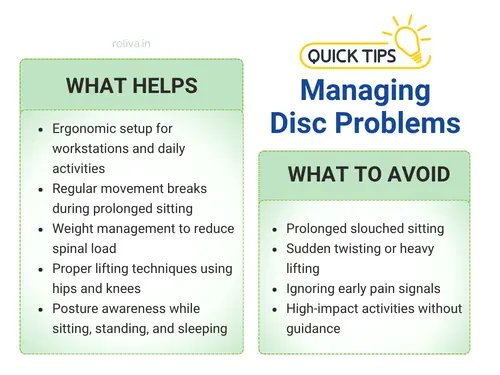
Lifestyle & Home Care Tips for Managing Disc Problems
Things to Avoid with Degenerative Disc Disease
Managing DDD doesn’t stop at the clinic. Daily habits play a major role in recovery and symptom control.
What Helps:
- Ergonomic setup for workstations and daily activities
- Regular movement breaks during prolonged sitting
- Weight management to reduce spinal load
- Proper lifting techniques using hips and knees
- Posture awareness while sitting, standing, and sleeping
What to Avoid:
- Prolonged slouched sitting
- Sudden twisting or heavy lifting
- Ignoring early pain signals
- High-impact activities without guidance
A personalised spinal physiotherapy treatment plan ensures that exercises and lifestyle changes suit your condition and recovery goals.

Frequently Asked Questions
Q. What exercises are safe for degenerative disc disease?
Ans. Low-impact exercises such as core stabilisation, pelvic tilts, stretching, walking, and guided strengthening exercises are generally safe. A physiotherapist should always tailor exercises to your condition.
Q. Can physiotherapy slow down disc degeneration?
Ans. Yes. While physiotherapy cannot reverse degeneration, it can slow progression, reduce pain, improve spinal support, and prevent future flare-ups.
Q. How long does it take to see improvement with physiotherapy?
Ans. Many patients notice pain relief within 2–4 weeks, with significant functional improvement over 6–12 weeks, depending on severity, consistency, and lifestyle factors.
Take the First Step Toward a Stronger, Pain-Free Back
Living with degenerative disc disease does not mean living with constant pain. With the right physiotherapy plan, everyday movements become easier, stiffness reduces, and your spine begins to support you the way it should. Small, consistent efforts, guided by the right expertise, can bring meaningful improvements to your daily comfort and mobility. If back pain has been limiting how you work, move, or live, this is the right time to seek help. A qualified physiotherapist can guide you with a personalised plan that fits your lifestyle, work routine, and comfort level.
If you’ve been searching for physical therapy for degenerative disc disease near me or wondering whether your ongoing back pain needs professional attention, physiotherapy is a proven, non-surgical solution. At ReLiva Physiotherapy & Rehab, degenerative disc disease is managed through structured spinal physiotherapy programs focused on pain relief, strength building, posture correction, and long-term spine health. Our approach is personalised, evidence-based, and designed to help you regain comfort and confidence without relying on surgery.
Whether your pain shows up every morning, worsens after long hours of sitting, or limits your movement, trained physiotherapists guide you through targeted solutions that restore strength, flexibility, and mobility, helping you move better and live better.
Ready to feel the difference?
ReLiva Physiotherapy & Rehab offers expert-led, personalised spine care to help you take control of your back health and move toward lasting relief.
This blogpost is based on the inputs from physiotherapist Dr. Ayushi Singh (PT). With a multi-disciplinary approach, orthopedic specialist Dr. Ayushi is a versatile physiotherapist in Navi Mumbai who works across all types of physiotherapy requirements. She regularly combines her clinical expertise, modern equipment, and a caring approach for complete recovery. Using specialised therapies and techniques like Cupping, Dry Needling and NDT (NeuroDynamics), she provides advanced treatments for back pain, knee pain, neck pain for clients of all ages and activity levels.
Scholarly References
[1] Journal of Cardiovascular Disease Research – Prevalence of Lumbar Disc Herniation and Disc Degeneration in Asymptomatic Indian Subjects: An MRI Based Study; Dr. Bhagya Lakshmi Bommineni, Dr. Prasanthi Meesala; DOI: https://doi.org/10.48047/
[2] Applied Biological Research – Quantification and Statistical Assessment of Lumbar Intervertebral Disc Spaces; P. Praveen, M.S. Mallikarjunaswamy, Mahabaleshwar Mamadapur and S. Chandrashekara; 30 November, 2024; DOI: 10.48165/abr.2024.26.01.58
[3] Global Spine Journal – Degenerative Lumbar Spine Disease: Estimating Global Incidence and Worldwide Volume