

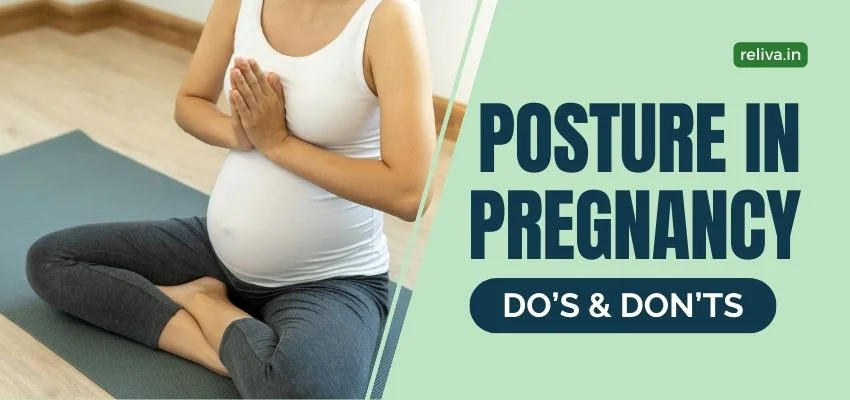

Posture is the position in which you hold your body while standing, sitting, or lying down. Good posture during pregnancy involves training your body to stand, walk, sit, and lie in positions where the least strain is placed on your back.
As your pregnancy progresses, changes in your body shape and centre of gravity can affect how you sit, stand, sleep and move. Everyday activities such as sitting and standing can become uncomfortable. Good posture can help reduce unnecessary strain and make everyday activities more comfortable. Following regular pregnancy exercises (supervised by an expert) could help you avoid certain common aches and pain related to increasing baby bump.
How can I improve my posture during Pregnancy?
We begin this post with a list of do’s and don’ts that will help you improve your posture during pregnancy and keep your body happy. Keep reading to find these pointers in detail.
You may also want to read : What’s causing your back pain? Is it poor posture
Good Posture during Pregnancy: Do’s
Here are few do’s or good practices that will help you improve your posture during pregnancy and keep your body happy.
- Irrespective of what your doing – cooking or working on a desk, remember to take a break every few hours
- Take a longer meal break every four hours
- Vary work positions continuously, from sitting to standing and walking.
- While sitting – use small pillow or cushion to provide extra support for your back
- Keep your hips and knees at a right angle when sitting (use a foot rest or stool, if needed). Your feet should be flat on the floor.
- While sitting, point your feet in the same direction, with weight balanced evenly on both feet
- Sleep on your left side with knees slightly bent with a pillow between your knees
- Try simple stretches or any sort of movements to keep the blood flowing. (Contact a ReLiva expert for a customized stretching program as per your stage of pregnancy)
- Try to practice relaxation techniques for stress free pregnancy.
- While standing, hold your head up straight with your chin in. Keep shoulder blades back and your chest forward, knees straight, buttocks tucked in.
Poor Posture during Pregnancy : Don’ts
Here are a few don’ts that will help you improve your posture during pregnancy and keep your pregnant body happy.
- Avoid prolonged standing.
- Avoid sitting in the same position for more than 30 mins
- Avoid crossing the leg while sitting
- Avoid sitting in lounging position or chair
- Don’t worry about frequent urination due to drinking plenty of fluids. It only gives you extra chance to change your position and move around.
- Avoid sleeping on your stomach
- Minimise heavy lifting, climbing or carrying.
- Avoid bending from waist. Only bend your knees while lifting
- Avoid twisting your body while lifting
- Do not wear high heels. The arches of your feet should be supported with low-heeled (but not flat) shoes to prevent stress on your back

Positions to Avoid During Pregnancy
There are few sitting or everyday positions that every pregnant woman must avoid. However, some positions can place unnecessary strain on your back and pelvis, particularly as pregnancy progresses. Avoid positions that cause discomfort, require prolonged twisting or slouching, or make it difficult to move comfortably.
In general:
- Avoid prolonged slouching, especially when sitting for work or relaxing. Support your lower back and keep your body comfortably upright.
- Avoid staying in the same position for too long. Change between sitting, standing and gentle movement regularly.
- Avoid prolonged leaning or twisting, particularly when reaching or lifting. Turn your whole body rather than repeatedly twisting through your spine.
- Avoid unsupported or uncomfortable sitting positions. A chair with good back support and feet comfortably supported can reduce strain.
- Avoid any position that clearly increases your back, pelvic or hip pain. If a particular position repeatedly causes pain, modify it rather than trying to push through it.
For women experiencing pelvic girdle pain (PGP), sitting on the floor, sitting twisted, crossing the legs and sitting or standing for long periods may aggravate symptoms.
Sitting Positions to Avoid During Pregnancy
The positions to avoid during pregnancy are mainly those that cause pain, prolonged slouching, twisting or prolonged pressure on the back and pelvis. There are few universally forbidden sitting positions, and what feels comfortable can change as pregnancy progresses.
Try to avoid:
- Slouching deeply into a sofa or chair.
- Sitting twisted to one side for prolonged periods.
- Sitting with your back unsupported.
- Sitting for long periods without changing position.
- Positions that cause or increase back or pelvic pain.
- Crossing your legs if this aggravates pelvic or hip discomfort.
A comfortable sitting position is usually more important than maintaining a rigid “perfect posture”. Support your back, keep your feet comfortably supported and change position regularly.
Important: RCOG specifically recommends changing position frequently and avoiding sitting for more than 30 minutes at a time for women with PGP.
Positions to Avoid During the First Trimester
During the first trimester, you generally do not need to avoid specific sitting positions simply because you are pregnant. Focus instead on comfortable, supported posture.
Avoid:
- Sitting in a deeply slouched position for prolonged periods.
- Staying seated in one position for too long.
- Sitting or standing in a position that causes back or pelvic discomfort.
- Repeated bending or twisting when lifting or reaching.
If a position feels comfortable and does not cause pain, there is usually no need to avoid it solely because you are in the first trimester.
Positions to Avoid During the Third Trimester
As your bump grows, your centre of gravity changes and some positions may become increasingly uncomfortable. Avoid positions that place excessive strain on your back or pelvis or make it difficult to move safely.
In particular:
- Avoid prolonged slouched sitting.
- Avoid sitting twisted or leaning heavily to one side.
- Avoid very low or soft seating if it makes getting up difficult.
- Avoid sitting or standing in one position for prolonged periods.
- Avoid positions that increase pelvic, hip or back pain.
- If you have pelvic girdle pain, avoid crossing your legs or sitting on the floor if these worsen your symptoms.
For sleep, the advice is different from daytime sitting. Later in pregnancy, side-sleeping is generally recommended rather than deliberately going to sleep flat on your back.
How should you sit in bed while pregnant?
- While sitting – use a small cushion to provide the extra support to the arch of your lower back; if needed.
- Take care that the back is straight and well supported.
- Keep your hips and knees at a right angle when sitting. Your feet should be flat on the floor. You may use a low stool to support the feet. (See this video to understand good posture for sitting: Good posture)
- While sitting, point your feet in the same direction, with weight balanced evenly on both feet
- Avoid slouched sitting – even though it may feel comfortable for a while but consistent slouching can stress the already sensitised muscles during pregnancy & increase the risk of aches & pains.
- While sitting, take care that the back is straight and well supported with knees bent & touching the floor. You may use a low stool to support the feet.
You may like to watch this video, Click below
 Sit, Stand, Sleep & Bend correctly during Pregnancy | Posture in Pregnancy | Dr Tanaya (PT), FabMoms
Is it ok to wear a seat belt in car when pregnant?

Just because you are pregnant; do not avoid the use of shoulder and the lap belt. Your safety matters all the more. Use the shoulder as well as the lap belt.
- Wear the lap belt under your belly closer to the hips.
- Shoulder belt must be placed between the breasts.
- In case you are driving, support the curve of the spine with a small cushion, pull the driving seat close to the steering wheel.
- Make sure your belly is around 10 inches away from the steering.
What is the best sleeping position when pregnant?
If you are pregnant, it is best to sleep on your left side with knees slightly bent with a pillow between your knees, unless suggested otherwise by your doctor.
Is it ok to lift something heavy during pregnancy?
- Try and avoid heavy weight if you are heavily pregnant. If you have to, then use both your hands to lift a weight.
- Even when you’re lifting something light, proper form can spare your back. Bend at your knees, not your waist. Keep the load close to your body, lifting with your legs — not your back.
What care should be taken while standing when pregnant?
- Avoid standing for longer duration.
- Keep changing the posture intermittently.
- When you need to stand longer, keep the feet separated & do not lock your knees.
- You can keep one foot on a small stool in case of long duration standing. This will take off the load/strain built up on your back due to long duration standing.
Posture for Sex during Pregnancy
Prenatal experts from ReLiva often come across pregnant women and their spouses wondering if Sex is safe during pregnancy. Given the nature of Indian culture and sensitivity to the topic, most find it uncomfortable to broach the topic even though they want to make an informed choice. At ReLiva we appreciate couples taking responsibility on this.
Sexual activity is common in pregnancy, but the frequency and positions for having sex varies among couples. Various research studies also suggest that sexual activity possibly declines with advancing stage of pregnancy. [1] Decreased sexual activity [2] may be caused by:
- nausea
- fear of miscarriage / harming the fetus
- lack of interest / discomfort
- physical awkwardness
- fear of infection
- fatigue
Is it safe to have sex during pregnancy?
As suggested by leading Ob-gyn organisations across the world, sexual activity is safe for women having healthy pregnancies. ACOG goes on to say, “This includes penetration and sexual intercourse. The amniotic sac and the strong muscles of the uterus protect the fetus.” However if you have any pregnancy complication like a weak cervix, a low-lying placenta, painful fibroids, leakage of amniotic fluid or are at risk of bleeding, pre-term labor or miscarriage, you need to check with your doctor or gynecologist / obstetrician.
Pregnancy Sex Positions

As the baby bump grows, it is natural to find conventional positions to be inconvenient and possibly unsafe. However, that doesn’t mean one has to stay away, unless advised by the supervising gynecologist and obstetrician.
- Classic missionary position is most suited during the first and second trimesters. If back feels uncomfortable, you may want to place a pillow to support your back and sit a little upright. In the third trimester this may not be a very comfortable position if the partner puts too much weight on the bump.
- Spooning position is considered suitable for all three trimesters. As the bump grows bigger in the third trimester, it needs more support and space, making this position even more practical.
- The expecting woman can always choose to be on the top to figure out a convenient angle and speed for her. This position is likely to work throughout the pregnancy.
What care should be taken during sexual activity when pregnant?
There may be other positions that could work for you. Whichever you choose, just know that:
- You should be comfortable and not be feeling under pressure or strain.
- Your back should be well supported (it is already under stress with the increasing weight and size of the uterus)
- Follow sitting and sleeping posture advice from the sections above and let your partner work around that to get intimate.
- Do tell your spouse know if anything feels uncomfortable, even if it is something you’re used to doing.
How does pregnancy affect posture?
Our Prenatal physiotherapists very often get asked this question. Afterall, how is pregnancy changing the normal body biomechanics.
Pregnancy changes your posture from being straight to arching your back with an added support from your hand to your back. These changes occur to accommodate your growing baby & manage your centre of gravity for better stability.
When a woman is pregnant, her pelvis begins to tip backwards as the baby develops, to balance the forward weight of the expanding uterus. As the pubic and tailbones move backward, the arch in the lower back increases. As the lower back arch increases, so does the curve in the upper back or thorax.
The shoulders and head move forward and the chest collapses to balance the changing weight. All these changes can increase stress on the spine, exaggerating its natural S shape. Other muscles and ligaments can also get strained.
If you would like to take a quick visual recap all these tips, watch this video
Pregnancy: Correct Posture | Dos and Don’ts | Dr Tanaya (PT) | FabMoms Prenatal Care
What are the common aches and pains arising due to posture changes during pregnancy?
Common discomforts/aches & pains experienced in pregnancy due to postural changes are briefed below:
These changes ultimately lead to serious back pains, neck pains & at times pelvic pains due to increased strain & muscular imbalances due to the changing postures.
- Forward head posture –
- Neck pain
- Headaches
- Pain between shoulder blades
- Nerve irritation in arms/hands
- Carpal tunnel syndrome
- Forward tilting of pelvis –
- Low back pain
- Pelvic pain
- SPD/PGP
- Increased lower back curve –
- Low back pain
- Nerve irritation in the legs (sciatica)
- Upper back/thoracic changes –
- Rib pain
- Difficulty in breathing due to reduced lung capacity
Expecting moms who have participated in FabMoms, a Prenatal Exercise Program have often reported lesser pregnancy related pains.

FAQs about Pregnancy Posture
What is the best position to sit in during pregnancy?
The best sitting position during pregnancy is one that keeps your back supported, your feet comfortably supported and your body relaxed without prolonged slouching or leaning to one side. Sit with your weight evenly distributed on both hips and change your position regularly. As your pregnancy progresses, you may need extra lower-back support or a cushion for comfort.
What sitting positions should be avoided during pregnancy?
Avoid sitting positions that involve prolonged slouching, twisting, leaning to one side or staying in the same position for too long. Very low or soft seating may also be uncomfortable as your bump grows. If you have back or pelvic pain, avoid any sitting position that clearly makes your symptoms worse. RCOG particularly advises women with pelvic girdle pain to avoid sitting on the floor, sitting twisted and prolonged sitting.
How should I sit during the first trimester?
During the first trimester, you can generally sit in any comfortable position that does not cause pain. Sit with your back supported, keep your feet comfortably supported and avoid prolonged slouching or staying in one position for too long. You do not need a special sitting position simply because you are in the first trimester.
How should I sit during the third trimester?
During the third trimester, sit with your back well supported, your feet supported and your weight evenly distributed rather than leaning or twisting to one side. Avoid very low seating if it makes getting up difficult, and change position regularly. If sitting causes back, hip or pelvic pain, modify the position and consider speaking to a physiotherapist.
Can pregnant women sit on the floor during the first trimester?
Yes, most pregnant women can sit on the floor during the first trimester if it is comfortable and they can get up safely. There is no general rule that floor sitting is unsafe in early pregnancy. However, if you have pelvic girdle pain or floor sitting causes discomfort, it is better to avoid it. RCOG specifically advises women with pelvic girdle pain to avoid sitting on the floor.
How long can you sit in one position during pregnancy?
There is no universal time limit for how long every pregnant woman can sit in one position. The important thing is to avoid prolonged, uninterrupted sitting and change position regularly. If you have pelvic girdle pain, RCOG advises changing position frequently and trying not to sit for more than 30 minutes at a time.
What positions are bad during pregnancy?
There are few positions that are universally “bad” during pregnancy. Positions become problematic when they cause pain, involve prolonged slouching or twisting, or leave you uncomfortable for a long time. If you have pelvic girdle or back pain, you may need to avoid specific positions that aggravate your symptoms rather than avoiding a particular position simply because you are pregnant.
Can poor posture affect pregnancy?
Poor posture during pregnancy can contribute to back, hip and pelvic discomfort, particularly as the growing bump changes your centre of gravity and the way you sit or stand. Good posture cannot prevent every pregnancy-related ache, but supportive positioning, regular movement and appropriate exercise can help reduce unnecessary strain. If pain is persistent or affecting daily activities, a physiotherapy assessment can help identify contributing factors.
What is the best posture during pregnancy?
The best posture during pregnancy is a comfortable, supported and changeable posture rather than one rigid position. When standing, aim for an upright position with your weight evenly distributed. When sitting, support your back and feet and avoid prolonged slouching. Change positions regularly and adjust your posture as your body and comfort needs change during pregnancy.
Is it safe to sit cross-legged during pregnancy?
Sitting cross-legged is generally not automatically unsafe during pregnancy, but it may become uncomfortable or aggravate pelvic or hip pain in some women. If you have pelvic girdle pain, RCOG recommends avoiding crossed legs because they can worsen symptoms. Otherwise, use comfort as your guide and change position regularly.
Struggling with back, pelvic or posture-related pain during pregnancy?
Pregnancy changes the way your body moves and carries weight. If pain is making it difficult to sit, stand, walk, sleep or manage everyday activities, pregnancy physiotherapy can help.
At ReLiva, our physiotherapists assess your posture, movement and symptoms and create a personalised programme to help you stay comfortable and active throughout pregnancy.
If you are in one of the 25+ cities with ReLiva Physiotherapy clinics, see our prenatal experts in person or simply consult them online. Don’t wait for the pain to become part of your routine. Get assessed by a ReLiva physiotherapist and learn how to move comfortably through pregnancy.
Book an appointment for Pregnancy Posture Assessment today!
Related Articles:
Benefits of exercise during Pregnancy
Posture in Pregnancy: Do’s & Don’ts
Happy & Fit Pregnancy; Back to Shape afterwards
……………
This article is based on the inputs from Dr Anuradha M. (PT) and Dr. Sriharika Jammula (PT). Both are a Certified Childbirth educators (USA) and immensely popular among women clients for their practical approach to prenatal and postnatal care, accurate diagnosis and treatment for women’s issues.
………………
Scientific References
[1] https://www.ncbi.nlm.nih.gov/pmc/articles/PMC3080531/
[2] Orji EO, Ogunlola IO, Fasubaa OB. Sexuality among pregnant women in South West Nigeria. J Obstet Gynaecol 2002;22:166–8 [PubMed] [Google Scholar] [Ref list]

