


Medically reviewed by Dr Sayali Muley (PT) – Updated November 2026.
Wallet Syndrome: Quick Answer
Wallet syndrome is buttock pain that refers to discomfort that may develop from prolonged sitting on a bulky wallet kept in the back pocket. The wallet can create localized pressure over the buttocks and alter the way a person sits. In some cases, sustained pressure may contribute to irritation of nearby soft tissues or the sciatic nerve, producing buttock pain or symptoms resembling sciatica.
Wallet syndrome is an informal name, not a formal diagnosis. Persistent or radiating pain should be clinically assessed to identify other possible causes.
What Is Wallet Syndrome?
Why Sitting on a Wallet Can Cause Buttock Pain
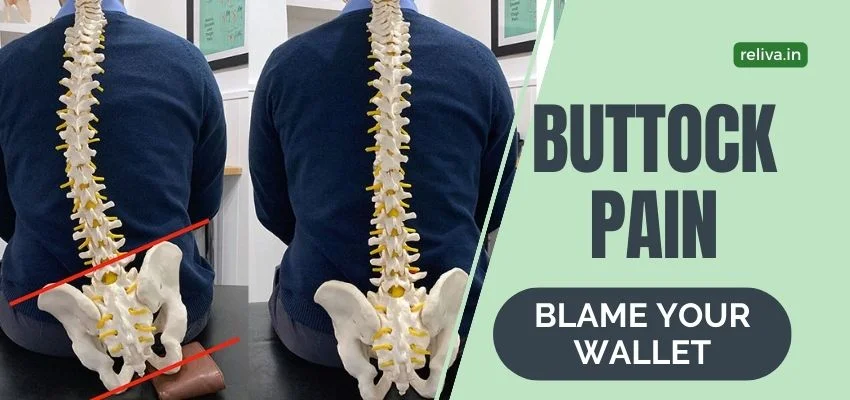
A bulky wallet in the back pocket lifts one side of the pelvis slightly higher than the other every time you sit, creating uneven, asymmetrical pressure through the buttock. Over hours of sitting, especially during long commutes or a full workday, this repeated pressure can irritate the muscles and soft tissue in that area, leading to a dull, persistent ache localised to one side. Quality of pain and distributions can vary from person to person.
A published case report, Wallet Neuritis: An Example of Peripheral Sensitization, described three patients with buttock and leg symptoms associated with sitting on a wallet. Although this provides clinical context for wallet-related nerve irritation, it is a small case report and does not establish how commonly this occurs. (Read the study)
Can a Wallet Affect the Sciatic Nerve?
Yes, in a sense. A bulky wallet may contribute to localized pressure in the gluteal region, potentially irritating tissues around the sciatic nerve. This can produce pain, tingling or discomfort radiating into the leg. Such symptoms may resemble lumbar radicular pain, although the underlying source may not be related to the spine. Clinical assessment is important to differentiate these conditions.
What Are the Symptoms of Wallet Syndrome?
Wallet-related buttock pain may develop when prolonged sitting puts pressure on tissues around the buttock and sciatic nerve. Certain everyday habits may contribute to symptoms, although other causes of buttock pain should also be considered.
Pain in One Buttock
Since the wallet sits on one side, pain is more noticeable on the side where the wallet is kept, rather than both sides equally.
Pain While Sitting
Buttock pain while sitting, is typically at its worst during sitting itself and tends to ease once you stand up and the pressure is relieved. Pain may be aggravated by sitting on firm surfaces, direct pressure over affected buttock or certain hip positions.
Buttock Pain While Driving
Buttock pain when driving can be a trigger, since the seated position is sustained for extended periods without a break — a familiar complaint among people with long commutes in Indian cities.
Tingling or Numbness in the Leg
Some people notice tingling, numbness, or a mild radiating sensation down the back of the thigh, related to nerve irritation from the sustained pressure.
Pain That Improves When You Stand or Remove the Wallet
Pain that worsens while sitting on a wallet and eases after removing it may suggest pressure-related irritation, although other causes of buttock pain should also be considered.

What Causes Wallet Syndrome?
Buttock pain from wallet pressure develops through a handful of everyday habits, making wallet syndrome causes fairly easy to identify once you know what to look for.
Sitting With a Wallet in the Back Pocket
The most direct and obvious cause — sitting for any meaningful length of time with a wallet in the back pocket sets up the pressure pattern responsible for symptoms.
A Bulky or Thick Wallet
Thicker wallets, especially those stuffed with cards, cash, or receipts, create more pressure and a bigger height difference between the two sides of the pelvis.
Long Hours of Sitting or Driving
The longer the sustained pressure, the more likely symptoms are to develop, which is why office workers and frequent drivers are particularly prone to this.
Poor Sitting Posture
Slouched or uneven sitting posture can add to the asymmetry already created by the wallet itself.
Repeated Pressure on One Side of the Buttock
Consistently sitting the same way, day after day, allows the irritation to build up over time rather than resolving between sessions.
Everyday Sitting Patterns That Add Pressure
Many daily routines involve long periods of sitting with something in the back pocket. Riding a two-wheeler, driving a car, auto or cab, working at a desk, or doing delivery work with frequent stops can all add sitting time on one side. A phone carried in the back pocket can create the same kind of uneven pressure as a wallet.
These habits do not mean you will develop buttock pain, and research on how often this happens is limited. But if your pain is worse after long rides or drives, check what is in your back pocket. Before you ride or drive, move your wallet and phone to a front pocket or a bag, and take short breaks when you can.
Is Wallet Syndrome the Same as Sciatica?
| Wallet Syndrome | Sciatica | |
|---|---|---|
| Main source | Possible pressure-related irritation around the buttock. | Usually lumbar nerve-root irritation |
| Pain | Buttock pain, sometimes with symptoms extending into the leg. | Usually: Pain radiating from the lower back or buttock into the leg; causes vary. |
| Sitting | Often strongly aggravates symptoms | May aggravate symptoms |
| Back pain | Usually absent | May be present |
| Key clue | Symptoms associated with sitting on a bulky wallet and improving after its removal | Radiating nerve pain, often below the knee (consistent with nerve-root involvement) |
If symptoms continue after removing the wallet, or extend significantly down the leg, a physiotherapy assessment can help determine whether another condition, such as true sciatica, is involved.
Read more → Sciatica Treatment
Wallet-related pressure is one possible explanation for buttock pain, but symptoms extending down the leg may have other causes, including lumbar nerve-root irritation.
Could It Be Something Other Than Wallet Syndrome?
Sciatic nerve irritation can occur outside the spine, including in the deep gluteal region. A systematic review of deep gluteal syndrome discusses these potential causes of buttock pain and sciatic-like symptoms. This is why symptoms should not automatically be attributed to wallet pressure; clinical assessment can help identify the likely source. (Read the systematic review)
Piriformis Syndrome
Deep buttock pain and sciatic-like symptoms can also stem from piriformis syndrome, where a muscle deep in the buttock irritates the nearby sciatic nerve, independent of any wallet involvement.
Sacroiliac Joint Dysfunction
Pain felt higher in the buttock, particularly with standing or single-leg loading like climbing stairs or transitional movements, may point toward the sacroiliac joint rather than pressure-related irritation.
Read our guide on Sacroiliac Joint Dysfunction.
Tailbone Pain
Pain felt directly around the coccyx, especially when it’s specifically worse while sitting, and transiting from sitting to standing may indicate coccydynia rather than wallet syndrome.
Lumbar Referred Pain or Sciatica
Pain originating from the lower back can also refer into the buttock and leg, which is why ruling out a spinal cause matters if symptoms don’t resolve with simple changes.
Other DDX: Proximal Hamstrings tendinopathy, Ischiofemoral Impingement, Hip-joint related Pathology.
Wallet Syndrome vs Other Causes of Buttock Pain
Typical patterns only. Many of these overlap.
| Cause | Where it hurts | What often makes it worse | What often helps |
|---|---|---|---|
| Wallet-related pressure | One buttock, usually on the side where the wallet is kept. May spread into the back of the thigh. | Sitting or driving with the wallet in the back pocket, long unbroken sitting, firm seats. | Removing the wallet before sitting, a slimmer wallet, regular movement breaks. Pain often eases after standing or removing the wallet. |
| Piriformis syndrome | Deep in the buttock. Sometimes along the back of the thigh. | Prolonged sitting, stairs, squatting, repeated hip movements. | Physiotherapy-guided hip and gluteal mobility and strengthening, and activity changes. |
| Sacroiliac joint dysfunction | One side of the lower back or upper buttock, near the pelvis. May spread to the groin or thigh. | Standing on one leg, climbing stairs, getting up from sitting, turning over in bed. | Physiotherapy-guided pelvic and hip strengthening, movement control and activity changes. |
| Lumbar referred pain or sciatica | Lower back, often with pain into the buttock and leg, sometimes below the knee. | Bending, lifting, long sitting or standing, and in some people coughing or sneezing. | An assessment to find the source, positions that ease symptoms, and graded exercises guided by a physiotherapist. |
These are typical patterns, and more than one problem can be present at the same time. An assessment is the most reliable way to tell them apart. Seek urgent medical care for new or worsening leg weakness, numbness around the groin or saddle area, or loss of bladder or bowel control.
How Is Wallet Syndrome Diagnosed?
Clinical Assessment
A physiotherapist assessment considers your pain location, sitting and driving habits, movement patterns, hip and lumbar movement, any neurological symptoms like tingling or numbness, and relevant provocation tests to rule in or rule out other causes.
Caution: Any new or progressive leg weakness, numbness around the groin or saddle area, or loss of bladder or bowel control needs urgent medical evaluation.
Do You Need an MRI?
Wallet syndrome is generally assessed clinically, without needing imaging. Imaging may be considered when symptoms are persistent, atypical, or suggest another underlying condition that needs closer evaluation.
How Is Wallet Syndrome Treated?
Remove the Wallet From Your Back Pocket
This is the obvious first intervention for pain from sitting on wallet pressure, and for many people, it’s enough on its own to allow symptoms to settle over time.
Modify Sitting and Driving Habits
Alternating pockets, switching to a front pocket, removing your wallet before sitting or driving, and taking regular movement breaks during long periods of sitting all help reduce the pressure that causes symptoms.
Physiotherapy for Wallet Syndrome
For symptoms that don’t fully resolve with these changes, physiotherapy at ReLiva Physiotherapy and Rehab may address ongoing pain and nerve irritation, hip mobility, gluteal strength, pelvic alignment and movement, and your overall sitting mechanics. Since sometimes the wallet was simply the trigger for an underlying issue that needs its own attention.
Exercises for Wallet Syndrome
The treatment programme is individualized according to the specific symptoms, functional limitations and examination findings. A short, targeted programme generally focuses on gentle hip mobility, gluteal strengthening, core and back strengthening, neural mobilization, graded functional activity, rather than an extensive exercise library.
How ReLiva Physiotherapy Assesses Wallet-Related Buttock Pain?
At ReLiva, physiotherapy assessment looks beyond the wallet itself to understand what may be causing your pain. Your physiotherapist evaluates your sitting habits, posture and movement, hip mobility and strength, lower-back function, and any symptoms such as tingling, numbness or pain travelling down the leg. This helps distinguish possible wallet-related pressure from other causes of buttock pain, so your treatment plan addresses the underlying problem—not just the trigger.
Could Your Sitting Habit Be Causing Your Buttock Pain?
Persistent buttock pain, tingling or discomfort while sitting may have more than one cause. A physiotherapy assessment at ReLiva can help identify the likely source and guide your recovery.
Buttock pain that continues after you change your sitting habits can be assessed at a ReLiva clinic in Mumbai, Bengaluru, Hyderabad, Chennai or Pune, or through home and online physiotherapy.
How Long Does Wallet Syndrome Take to Improve?
Symptoms caused mainly by pressure from a wallet often improve fairly quickly after removing the aggravating factor. Persistent symptoms may take longer to resolve, particularly when nerve irritation or an underlying movement problem is contributing alongside the wallet itself. Overall recovery time depends on how long symptoms have been present and what other factors, if any, are involved.
How to Prevent Wallet Syndrome
Avoid Sitting on a Bulky Wallet
Keeping your wallet slim, or out of your back pocket entirely while sitting or driving, is the simplest form of prevention.
Change Position Regularly
Avoiding long, unbroken periods of sitting helps prevent sustained pressure from building up in the first place.
Improve Sitting and Driving Posture
Good even posture reduces additional strain that can compound the effect of pressure from a wallet.
Address Recurring Buttock Pain
If buttock pain keeps recurring despite these changes, it’s worth having it properly assessed rather than assuming it will always resolve on its own.

FAQs About Wallet Syndrome
Can Sitting on a Wallet Cause Sciatica?
Sitting on a wallet doesn’t cause true sciatica from the lower back, but sciatic nerve pain from wallet pressure can irritate the nerve locally in the buttock, producing similar symptoms.
Can a Wallet Cause Buttock Pain?
Yes, a bulky wallet in the back pocket creates uneven pressure while sitting, which is a recognised cause of one-sided buttock pain.
Can Wallet Syndrome Cause Leg Pain?
In some cases, yes. Pressure on the nerve near the buttock can cause tingling, numbness, or mild radiating discomfort into the back of the thigh.
How Do You Get Rid of Wallet Syndrome?
Removing the wallet from your back pocket and adjusting sitting habits resolves many cases. Physiotherapy at ReLiva Physiotherapy and Rehab can help if symptoms persist despite these changes.
Should I Stop Keeping My Wallet in My Back Pocket?
It’s a sensible habit to adopt, especially if you sit or drive for long periods, since it removes the cause of this type of buttock pain entirely.
When Should I See a Physiotherapist for Buttock Pain?
See a physiotherapist at ReLiva Physiotherapy and Rehab if your pain persists after removing the wallet, extends down the leg, or doesn’t improve with simple changes to your sitting habits.
Still Having Buttock Pain After Removing Your Wallet?
If buttock pain persists despite changing your sitting habits, the cause may not be the wallet alone. A physiotherapy assessment at ReLiva Physiotherapy and Rehab can identify whether the pain is related to nerve irritation, muscle dysfunction, the sacroiliac joint, hip, or lower back.
….
This article has been medically reviewed by physiotherapist Sayali Muley.
Dr. Sayali Muley (PT) is a leading physiotherapist in Pune, specializing in advanced rehabilitation. With a BPT, MPT (Neuro), and international certification in Clinical Neurodynamics (NDS Australia), she brings global expertise to local care. Certified in dry needling and electro‑acupuncture, she is skilled in cupping therapy, K‑Taping, mirror therapy, myofascial release, gait training, and muscle energy techniques. Proficient in Brunnstrom, PNF, Bobath, CIMT, and MRP approaches, she helps patients with stroke, spinal cord injuries, and neurological disorders regain mobility, independence, and confidence

