


Medically reviewed by Dr. Nabeel Hameed (PT) – Updated October 2026.
Do You Really Need an MRI for Knee Pain?
Not necessarily. An MRI is not usually the first investigation for uncomplicated knee pain. A knee pain treatment with physiotherapy assessment can often identify the likely contributors and guide initial treatment. MRI may become appropriate after significant injury, persistent symptoms, suspected internal knee damage, or when imaging would change treatment decisions.
This isn’t about avoiding useful tests, it’s about using them at the right time. Physiotherapists are trained to pick up on patterns: when your pain started, what movements trigger it, how your knee moves and functions, and where exactly the pain is located. In many cases, these clinical findings paint a clear enough picture to begin treatment immediately, without the cost, wait time, or unnecessary worry of jumping straight to a knee MRI. Understanding when an MRI is actually needed can help you avoid unnecessary imaging while making sure you don’t delay an investigation when it could change your treatment.
What Does an MRI Show?
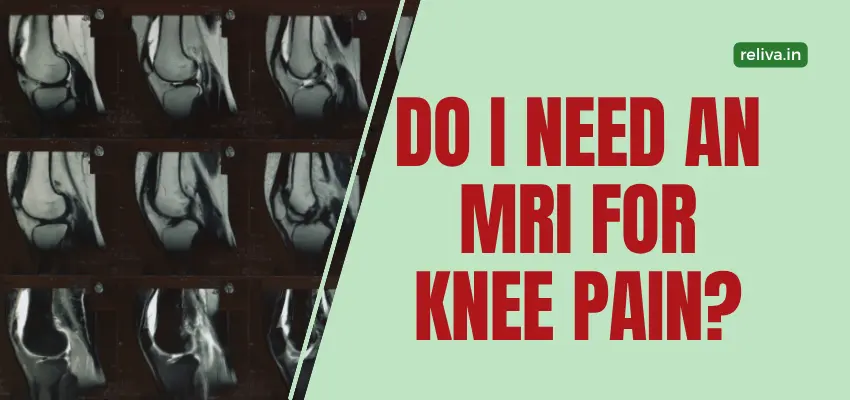
An MRI scan for knee pain (Magnetic Resonance Imaging) is particularly good at showing the soft tissue structures inside the knee that other imaging types, like X-rays, can’t capture clearly. This includes cartilage, ligaments, the meniscus, tendons, and surrounding muscles. It gives a detailed picture of these structures, which is why it’s often used when a soft tissue injury, like a ligament tear or meniscus damage, is genuinely suspected. That said, having detailed images doesn’t automatically mean they’ll change how you’re treated, which is an important distinction covered further down this page.
When Is an MRI Usually Recommended?
An MRI may be recommended when a knee injury is suspected to involve structures such as the meniscus or ligaments, when symptoms persist despite appropriate treatment, or when the diagnosis remains unclear. MRI is not usually needed as the first investigation for uncomplicated knee pain.
While most knee pain doesn’t need imaging right away, there are specific situations where an MRI genuinely adds value.

-
After a Significant Injury
A fall, direct impact or forceful twist may warrant further assessment for internal knee damage.
-
Suspected Ligament Injury
Instability after a twisting injury can indicate ligament damage that may need further imaging.
-
Possible Meniscus Tear
Persistent locking, catching or joint-line pain can raise suspicion of a meniscus injury.
-
Persistent Symptoms Despite Treatment
If symptoms do not improve with appropriate treatment, MRI may help clarify the diagnosis or next step.
-
When Surgery Is Being Considered
MRI can provide detailed information about the knee when surgery is being considered.
-
When the Diagnosis Remains Unclear
If clinical assessment does not clearly identify the cause of pain, MRI may provide additional information.
Read our indepth guide on Treating knee pain without surgery.
| Situation | Is MRI commonly considered? |
| Significant injury with suspected internal damage | May be appropriate after clinical assessment |
| Suspected ligament injury with instability | May be appropriate |
| Persistent locking/catching suggesting meniscal injury | May be appropriate |
| Symptoms not improving with appropriate treatment | May be considered to clarify next steps |
| Surgery is being considered | May help with treatment planning |
| Gradual knee pain without significant injury | Usually not the first imaging test |
When You May Not Need an MRI Right Away
Several common presentations of knee pain generally don’t require immediate imaging:
- Gradual, non-traumatic knee pain
- Early arthritis symptoms
- Knee Pain that occurs when walking
- Knee Pain that occurs on stairs climbing
- General muscle weakness contributing to symptoms
- Overuse-related pain from activity or exercise
Many of these presentations can be managed initially with appropriate physiotherapy and do not require immediate imaging.
Not sure where your pain is coming from? Read about front knee pain around the kneecap and inner knee pain on the inside of the knee. Our guide to knee pain exercises recommended by physiotherapists explains which exercises are commonly used and when to be careful.
What Should I Do First for Knee Pain: MRI, X-ray or Physiotherapy?
The right first step depends on how your knee pain started, your symptoms and what the clinical examination shows. An MRI is not automatically the first investigation.
Gradual knee pain without a major injury
- Start with a clinical or physiotherapy assessment
- Begin treatment based on the findings
- Consider imaging if it is clinically indicated; an X-ray may be used first in some cases
Acute injury, significant trauma, instability or a locked knee
- Seek medical assessment
- Imaging is decided based on the injury and examination findings
- MRI may be useful when internal knee damage is suspected
Persistent symptoms despite appropriate treatment
- Reassess the knee and your response to treatment
- Consider imaging if the result could clarify the diagnosis or change the next step
The aim is not to avoid imaging, but to use the right investigation at the right stage rather than assuming that every knee problem needs an MRI.
Do You Need an MRI Before Seeing a Physiotherapist?
You do not necessarily need to arrange an MRI before your first physiotherapy assessment. In India, you can start with a physiotherapy assessment rather than arranging a knee MRI in advance, unless you have already been advised to get imaging by a doctor.If your symptoms and examination suggest that rehabilitation is appropriate, treatment can often begin without waiting for imaging. If imaging is likely to change the next step, your physiotherapist can explain when medical or orthopaedic referral is appropriate.

Physiotherapy Assessment Before MRI
Movement-Based Clinical Assessment Before Imaging
This is the defining message of this page: at ReLiva Physiotherapy and Rehab, physiotherapists evaluate symptom behaviour, gait, stair negotiation, strength, range of motion, balance, and functional tasks to understand the likely source of your pain — before imaging is even considered. This positions MRI as a tool that complements, rather than replaces, a thorough clinical assessment.
During your assessment, a ReLiva physiotherapist evaluates:
- How you walk
- How you manage stairs
- Your muscle strength
- Your knee’s movement and range of motion
- Your balance
- Joint mobility throughout the leg
- How your pain behaves — what triggers it, what eases it, and its overall pattern
Sometimes these findings clearly indicate that rehabilitation is the appropriate next step, without needing immediate imaging. Other times, they point toward a case that genuinely warrants a referral for MRI or specialist opinion. Either way, this assessment is what determines the right path for you specifically, rather than defaulting to a scan for every knee complaint.
The aim is not to replace appropriate medical imaging, but to determine whether your presentation can reasonably begin with rehabilitation or whether further investigation or specialist assessment is warranted.
Not sure whether your knee pain needs an MRI?
A physiotherapy assessment can help identify the likely contributors to your symptoms and determine the appropriate next step.
MRI vs X-ray: What’s the Difference?
MRI vs X-ray: Which Is Better?
Neither test is universally better. X-rays are mainly used to assess bones, fractures and joint changes such as osteoarthritis, while MRI provides more detail about soft tissues such as the meniscus, ligaments and cartilage. The appropriate test depends on the suspected problem and clinical findings.
When Is an X-ray Usually More Useful?
An X-ray is generally more useful for assessing bones and joint changes, such as:
- Suspected fractures or other bony injury
- Osteoarthritis and degenerative joint changes
- Chronic knee pain when initial imaging is indicated
When Can MRI Add Information?
MRI provides more detail about the soft tissues inside and around the knee, including:
- Meniscus injuries or tears
- Ligament injuries
- Cartilage problems
- Selected tendon and other soft-tissue conditions
Key point: The choice between X-ray and MRI depends on the suspected problem and clinical findings. MRI is not automatically a better test simply because it provides more detail.
| MRI | X-ray |
|---|---|
| Soft tissues | Bones |
| Ligaments | Joint space |
| Meniscus | |
| Cartilage | Fractures |
Can Physiotherapy Start Before an MRI?
Yes, in many cases. If the clinical assessment suggests that immediate imaging is not necessary, physiotherapy can often begin based on the symptoms, movement and functional findings. If symptoms do not improve or the assessment raises concern about an internal injury, further medical evaluation or imaging may be recommended.
What Happens If Your MRI Shows “Wear and Tear”?
This is an important point many people aren’t told clearly enough: imaging findings don’t always match symptoms. Research using high-resolution MRI on people with no knee symptoms at all found abnormalities, including meniscal tears and cartilage changes, in the vast majority of knees scanned (Springer, Skeletal Radiology). A separate systematic review found that features like cartilage defects and meniscal tears are commonly seen on MRI in people with completely asymptomatic, uninjured knees, with prevalence increasing with age (PubMed). This reinforces why clinical reasoning matters just as much as, if not more than, imaging findings alone — a “wear and tear” result on your scan doesn’t automatically explain your pain, and it doesn’t mean surgery is your only option.
When Should You Book a Physiotherapy Assessment?
You should consider booking a physiotherapy assessment if you’re experiencing pain lasting more than two weeks, pain that’s limiting your walking, difficulty climbing stairs, repeated swelling, or if home treatment hasn’t helped.
Should I Get an MRI? A Simple Decision Pathway
- Recent injury with inability to bear weight, or a popping sensation at the time of injury?
→ Seek urgent medical evaluation; MRI may be indicated after clinical assessment.
- Gradual pain without significant trauma?
→ A physiotherapy assessment is often the appropriate first step.
- Persistent symptoms despite a genuine trial of rehabilitation?
→ MRI may help refine the diagnosis or treatment plan at this stage.
Not sure whether you actually need an MRI?
Start with a knee physiotherapy assessment.
A ReLiva physiotherapist can assess your symptoms, movement and function and help determine whether rehabilitation is an appropriate first step or whether you should seek further medical evaluation or imaging.

Frequently Asked Questions
Can Physiotherapists Diagnose Knee Problems Without MRI?
A physiotherapist can often identify the likely contributors to knee pain through a detailed clinical and movement assessment. If the findings suggest that imaging or specialist assessment is needed, they can recommend the appropriate next step.
Will MRI Always Identify the Cause?
Not necessarily. MRI findings don’t always match a person’s symptoms, and many people have MRI abnormalities without any pain at all, which is why physiotherapists at ReLiva Physiotherapy and Rehab rely on clinical assessment alongside imaging rather than imaging alone.
Should I Get an MRI Before Seeing a Physiotherapist?
Usually not. Starting with a physiotherapy assessment at ReLiva Physiotherapy and Rehab often clarifies whether imaging is genuinely needed in your specific case.
Is MRI Better Than X-ray?
It depends on what’s suspected. MRI is better for soft tissues like ligaments and the meniscus, while X-ray is better for bones, joint space, and fractures.
Can Arthritis Be Diagnosed Without MRI?
Yes, arthritis is often diagnosed through clinical assessment and, if needed, a simple X-ray, without requiring an MRI in most straightforward cases.
Key Takeaways
- MRI is not usually the first step for knee pain. A clinical assessment can help determine when imaging is actually needed.
- MRI is genuinely useful after significant injury, suspected ligament or meniscus tears, or when surgery is being considered.
- MRI findings, like “wear and tear,” don’t always match symptoms and don’t automatically mean surgery is needed.
- Physiotherapy can safely start before an MRI in most cases, often improving symptoms without ever needing a scan.
Not sure whether you need an MRI?
Start with a knee assessment at ReLiva. A physiotherapist can assess your symptoms, movement and function to determine whether physiotherapy is an appropriate first step or whether further medical evaluation, imaging or orthopaedic referral is needed.
This article has been reviewed by Dr. Nabeel Hameed (PT).
Dr. Nabeel Hameed (PT) is an experienced physiotherapist with over 12 years of clinical practice. Certified in dry needling technique and kinesio taping, eclectic stroke rehabilitation, and NDT, he brings advanced expertise in neuro and musculoskeletal care. Skilled in manual therapy, McKenzie, Mulligan’s, myofascial release, gait training, and muscle energy techniques, he offers comprehensive rehabilitation solutions. His patient-centered approach emphasizes restoring function, improving mobility, and promoting long-term recovery, making him a trusted name in physiotherapy care in Kozhikode.

