


Medically reviewed by Dr. Divya E (PT) – Updated October 2026.
Quick Answer: What Causes Front Knee Pain?
Front knee pain, or pain around the kneecap, can be caused by patellofemoral pain, patellar tendon irritation, osteoarthritis, muscle weakness or changes in how the knee is loaded during activities. The exact cause depends on where the pain occurs, what triggers it and whether it followed an injury. A physiotherapist can assess your knee, hip and ankle movement, strength and functional activities to identify contributing factors and guide treatment.
What Does Front Knee Pain Mean?
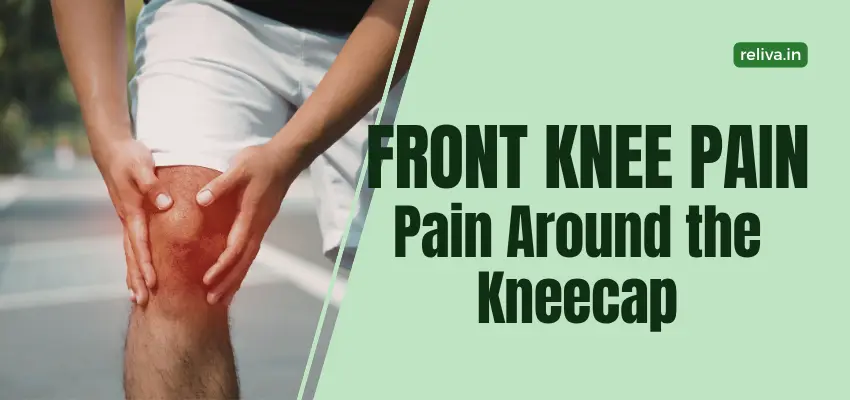
Front knee pain refers to pain around or behind the kneecap, known as the patella, or just below it. It’s extremely common in people who climb stairs regularly, squat, run, kneel, or sit for prolonged periods, all everyday realities for many people in India, whether it’s climbing stairs in homes without lifts, squatting during prayer or floor-based cooking, or long hours seated at a desk or during commutes.
The location of your pain around the kneecap, or front knee pain, as some describe it, helps narrow down the possible causes, but a proper movement assessment is essential to identify the actual underlying problem. Physiotherapy for knee pain around the front of the joint focuses on understanding not just where it hurts, but why the kneecap is being overloaded in the first place.

Where Exactly Is the Pain Around Your Kneecap?
Pinpointing exactly where your pain in front of your knee sits is one of the most useful clues in narrowing down the cause.
Pain Behind the Kneecap
Pain felt behind the kneecap itself is often linked with patellofemoral joint irritation, where the kneecap isn’t gliding smoothly within its groove during movement.
Pain Below the Kneecap
Pain below kneecap level is often associated with the patellar tendon, the strong tissue connecting the kneecap to the shin bone, and tends to flare up with jumping, running, or repeated stair use. This is sometimes described by patients as a tender spot just under the kneecap that’s noticeably worse after activity.
Pain Above the Kneecap
Pain felt just above the kneecap may relate to the quadriceps tendon or general muscle overload, particularly after activities that heavily load the front of the thigh.
Pain Around the Entire Kneecap
A more generalised ache around the whole kneecap can occur with altered movement mechanics affecting the joint broadly, or with early arthritis in this part of the knee.
Pain Around or Behind the Kneecap: Hoffa’s Fat Pad
Pain at the front of the knee can also arise from irritation of Hoffa’s fat pad, a soft fatty tissue structure located beneath the kneecap and behind the patellar tendon. Fat pad irritation can be considered when pain is localised to the area below or around the kneecap, particularly when symptoms are aggravated by certain knee movements.
| Pain Location | Likely Source |
|---|---|
| Behind the kneecap | Patellofemoral joint irritation |
| Below the kneecap | Patellar tendon irritation |
| Above the kneecap | Quadriceps tendon or muscle overload |
| Around the entire kneecap | Altered movement mechanics, early arthritis |
| Below or around the kneecap | Hoffa’s fat pad irritation |
Common Causes of Front Knee Pain
Patellofemoral Pain Syndrome
This is one of the most common causes of anterior knee pain, occurring when the kneecap doesn’t track smoothly within its groove during bending and straightening. It often shows up specifically with activities that load the knee in a bent position, such as squatting, stairs, or sitting for long periods.
Patellar Tendon Irritation
Overuse of the patellar tendon, often from repetitive jumping or running, can lead to localised pain just below the kneecap. This is sometimes referred to as “jumper’s knee” in sporting contexts.
Early Knee Osteoarthritis
Wear affecting the front of the knee joint can contribute to kneecap pain, particularly with prolonged activity.
Read more: Knee Osteoarthritis Physiotherapy
Muscle Weakness and Poor Knee Control
Muscle weakness and poor knee control can contribute to ongoing front knee pain and may be addressed through targeted rehabilitation. Quadriceps weakness reduces the muscle’s ability to properly control kneecap movement and absorb load, particularly during activities that involve bending the knee under body weight, such as squatting or descending stairs.
Gluteal weakness may allow the hip and knee to fall out of good alignment during activities like stair climbing and bending down to sit on low seats, indirectly increasing strain on the kneecap with every step or squat. Poor hip control means the thigh can rotate inward during movement, changing how the kneecap tracks within its groove and creating uneven pressure across the joint surface.
Altered lower-limb alignment — how the hip, knee, and foot line up together during movement can concentrate extra force specifically on the front of the knee over time, often without the person noticing the pattern developing until pain sets in. Repetitive overload, from frequent stair use, squatting, or running without adequate strength to support these demands, gradually builds up and contributes to ongoing irritation. Addressing the relevant movement factors, rather than the painful structure alone, is usually what leads to lasting improvement rather than temporary relief.
Activities That Commonly Trigger Front Knee Pain
Climbing Stairs
Stairs place significant load through a bent knee, which is exactly the position that tends to aggravate kneecap pain.
For more detail, see our guide to knee pain when climbing stairs.
Squatting and Kneeling
Deep squatting and kneeling positions, common in Indian households during floor-based activities like cooking, cleaning, or prayer, place considerable strain on the front of the knee.
When getting up from a low seat or sitting on the floor, use a stable support or armrest where available, place your feet firmly on the ground and rise slowly. Avoid forcing a deep knee bend if it increases pain. You can temporarily use a higher chair to make sitting down and standing up more comfortable.
Running and Jumping
The repeated impact and knee bending involved in running and jumping can aggravate both patellofemoral pain and patellar tendon irritation.
Sitting for Long Periods
Prolonged sitting with the knee bent, such as in a movie theater, can cause a dull ache around or behind the kneecap, sometimes called the ‘theatre sign‘. It is a recognised feature of patellofemoral pain, particularly when symptoms become worse during prolonged sitting, such as at a cinema or during a long journey. This pattern is one reason your physiotherapist may ask when your pain appears, rather than focusing only on where it hurts.
Increased Body Weight
Higher body weight can increase the load placed on the knee during weight-bearing activities, potentially contributing to symptoms, particularly with repeated activities such as stairs, squatting and walking.
Changes in Training Intensity or Activity
A sudden increase in running, jumping, walking or exercise intensity can increase knee loading faster than the tissues can adapt, contributing to pain or irritation.
What Can You Do at Home for Front Knee Pain?
If you have mild front knee pain, these steps may help manage symptoms:
-
Reduce painful activities: Temporarily reduce running, jumping or other activities that aggravate your pain.
-
Avoid deep squats for now: Reduce deep knee bending if it increases discomfort.
-
Keep moving gently: Continue comfortable walking and gentle knee movements rather than resting completely, if tolerated.
-
Try appropriate exercises: Explore these knee pain exercises recommended by physiotherapists and choose exercises suited to your symptoms.
Seek a physiotherapy assessment if pain persists, worsens or limits everyday activities.
How Physiotherapists Identify the Cause of Front Knee Pain?
Movement Analysis of Patellofemoral Loading : How ReLiva Assesses Front Knee Pain During Movement
At ReLiva Physiotherapy and Rehab, rather than focusing purely on scans or anatomy, physiotherapists assess how you actually move: walking and stair mechanics, squat movement, sit-to-stand control, single-leg balance, hip and ankle contribution, and how the kneecap tracks during real functional tasks. This movement-based approach is what sets rehabilitation-focused physiotherapy apart from purely diagnosis-focused advice.
Understanding Pain During Movement
Your physiotherapist will ask specifically when your pain shows up, during walking, on stairs, during squats, with sit-to-stand transitions, or while running, since each activity loads the kneecap slightly differently.
Assessing Movement Quality
A thorough assessment checks strength, flexibility, balance, hip and ankle mobility, and how the patella moves through its range, building a complete picture rather than a single snapshot.
Identifying the Movement Impairment
The same pain around the kneecap can arise from entirely different movement problems in different people. This is exactly why rehabilitation should be individualised based on your specific assessment findings, rather than based solely on the diagnosis label.
Physiotherapy Treatment for Front Knee Pain
Reducing Pain and Irritation
Early treatment focuses on calming the kneecap down through activity modification and appropriate techniques, without requiring complete rest.
Improving Joint and Soft Tissue Mobility
Restoring mobility around the kneecap and surrounding soft tissue helps normalise movement before strengthening work is added.
Strengthening Muscles That Support the Kneecap
A structured programme targets the quadriceps, gluteals, hip abductors, calf, and core, since weakness in any of these areas can contribute to poor kneecap tracking. For examples of exercises commonly used in knee rehabilitation, see knee pain exercises recommended by physiotherapists.
Correcting Movement Patterns
Treatment addresses how you move during activities relevant to daily life — walking, stairs, squatting for tasks like floor seating or gardening, and running mechanics where relevant, correcting the specific patterns overloading the front of the knee.
Returning to Daily Activities and Sport
Recovery at ReLiva Physiotherapy and Rehab follows a progressive sequence: reduce pain, restore mobility, improve muscle control, retrain functional activities like stairs, squatting, and walking, and finally return to sport or full daily life with confidence.
Front Knee Pain Affecting Your Daily Activities?
If front knee pain is making stairs, squatting, walking or exercise difficult, a physiotherapy assessment can help identify the factors contributing to your symptoms and guide a personalised rehabilitation plan.
Can You Continue Exercising with Front Knee Pain?
In most cases, yes, with some adjustment. Walking is usually well tolerated and can continue with minor modification if needed. Cycling is often a good option, since it loads the knee more predictably than high-impact activity. Running may need to be temporarily reduced or modified, since repeated impact can aggravate an irritated kneecap. Gym exercises involving deep knee bending, like deep squats or lunges, may need adjusting in range or load until strength and control improve. A physiotherapist can guide you on exactly which activities to continue, modify, or pause.

When Should You See a Physiotherapist?
You should see a physiotherapist if you’re experiencing:
- Persistent pain that isn’t settling
- Difficulty managing stairs
- Pain that’s affecting your work
- Pain that’s limiting your ability to play sport
- Recurrent episodes of front knee pain
- Unusual pain in sports activities or training
If any of these apply to you, a proper assessment can identify the real cause of your kneecap pain and guide the right treatment approach.
Recovery Timeline for Front Knee Pain (Pain around Kneecap)
Recovery from front knee pain varies depending on the underlying cause, severity of symptoms and individual response to treatment. As a general guide, mild patellofemoral pain may improve within 4–8 weeks, while moderate symptoms may take 8–12 weeks. Patellar tendon irritation may require 6–12 weeks or longer. Your individual recovery timeline may differ.
How Can You Prevent Front Knee Pain?
Not all cases of front knee pain can be prevented, but these strategies may help reduce the risk:
- Maintain lower-limb strength through regular training.
- Increase exercise intensity gradually.
- Use appropriate footwear.
- Address knee pain early rather than training through it.
- Include mobility exercises in your routine.
- Seek assessment from a qualified physiotherapist rather than relying solely on internet advice or self-diagnosis.
When Is Front Knee Pain an Emergency?
Seek prompt medical attention if you have inability to bear weight, a knee that becomes locked or stuck, significant instability or repeated giving way, or severe swelling after a fall or injury. Knee pain accompanied by fever also warrants medical assessment, as it may indicate an underlying infection or other condition requiring urgent care.

Frequently Asked Questions
Why Does the Front of My Knee Hurt?
Front knee pain is often caused by patellofemoral pain syndrome, patellar tendon irritation, or muscle weakness affecting how the kneecap moves. A proper assessment at ReLiva Physiotherapy and Rehab can identify the exact cause.
Why Does My Kneecap Hurt While Climbing Stairs?
Stairs place significant load through a bent knee, which increases pressure behind the kneecap, particularly if the surrounding muscles aren’t controlling that load well. A physiotherapist at ReLiva Physiotherapy and Rehab can assess exactly what’s contributing to this in your case.
Can Weak Thigh Muscles Cause Front Knee Pain?
Yes, Quadriceps weakness can contribute to front knee pain because the quadriceps help control knee movement and load during activities such as stairs and squatting, since they play a central role in controlling kneecap movement.
Is Front Knee Pain Always Arthritis?
No. Front knee pain has several possible causes, including patellofemoral pain, patellar tendon problems, osteoarthritis and other movement-related factors.
Can Physiotherapy help front knee pain / around knee cap?
Yes. Physiotherapy can help manage front knee pain by addressing relevant factors such as strength, mobility, movement control and activity tolerance. A ReLiva physiotherapist can assess your symptoms and movement to develop a personalised treatment and rehabilitation plan.
Do I Need an MRI?
Not usually at first. Most cases of front knee pain can be assessed and treated clinically, with imaging reserved for cases that don’t respond as expected. If you’re considering non-surgical treatment options, see knee pain treatment without surgery.
How Long Does Recovery from Front Knee Pain Take?
Recovery varies depending on the cause, severity and individual response to treatment. Your physiotherapist can give you a more individualised recovery estimate after assessment.
Is Walking Good for Front Knee Pain?
In many cases, walking can be continued with appropriate activity modification. However, if walking increases or consistently aggravates your pain, a physiotherapist can assess your symptoms and movement to determine suitable activity modifications and rehabilitation strategies. Read our guide on Knee pain while walking.
Key Takeaways
- Front knee pain refers to pain around, behind, above, or below the kneecap, and its exact location offers useful clues.
- A physiotherapy assessment goes beyond pain location, using movement analysis to identify the real underlying cause.
- Muscle weakness, especially in the quadriceps and glutes, can contribute to kneecap pain and may be addressed through targeted physiotherapy based rehabilitation.
- Everyday activities like stairs, squatting, and prolonged sitting commonly trigger or aggravate front knee pain.
- The same pain location can stem from different movement problems in different people, so treatment should be individualised.
- A structured, progressive physiotherapy programme at ReLiva Physiotherapy and Rehab helps you return to daily activities and sport with confidence.
Ready to Get Back to Pain-Free Movement?
Front knee pain can have different causes. A ReLiva physiotherapist can assess your knee, movement, strength and functional activities to understand what may be contributing to your symptoms and plan your rehabilitation.
This article has been reviewed by Dr. Divya E (PT) .
Dr. Divya (PT) specializes in physiotherapy for orthopedic conditions including spine, joints, sports injuries, and post-operative rehabilitation. Certified in Manual Therapy, Dry Needling, and Metabolic Health, she excels in Geriatric rehabilitation, fall prevention, and improving functional independence. Skilled in Mulligan’s, Myofascial Release, MET, and Pelvic Floor Therapy for women, she is dedicated to helping patients achieve lasting recovery and improved quality of life.

