



Medically reviewed by Dr. Hetvi Shah (PT) – Updated July, 2026.
Spine arthritis is one of the most common causes of persistent back and neck pain in adults over 40, yet it’s frequently dismissed as “just ageing.” Understanding the broader principles of spine arthritis treatment can help individuals seek appropriate care early.
The truth is, facet joint arthritis can significantly limit your movement, disrupt sleep, and make everyday tasks feel like a chore. It is commonly associated with age-related joint degeneration, similar to other forms of osteoarthritis treatment focused on preserving movement and reducing pain. The good news: with the right physiotherapy approach, most people manage spine arthritis effectively without surgery.
This guide covers everything you need to know, what’s happening in your spine, what symptoms to watch for, and how physiotherapy helps you move and live better.
- Spine Arthritis (Facet Joint Arthritis) : Overview
- Spine Arthritis vs Disc Problems vs Spondylosis
- Symptoms of Spine Arthritis
- How Spine Arthritis Affects Daily Activities
- Causes & Risk Factors
- Diagnosis of Spine Arthritis
- Treatment Options
- Physiotherapy for Spine Arthritis
- Best Exercises for Spine Arthritis
- Daily Tips to Manage Spine Arthritis
- When to See a Physiotherapist?
- Can Spine Arthritis Be Managed Without Surgery?
- FAQs on Spine Arthritis
What is Spine Arthritis (Facet Joint Arthritis)?
Spine arthritis refers to the breakdown of cartilage within the facet joints of the spine, the small, paired joints that connect each vertebra to the one above and below it. As this cartilage wears down, the joints become inflamed, stiff, and painful. Basically, it is the inflammation or degeneration of the joints, discs, and cartilage in your spine.
Also called facet joint arthropathy or facet joint syndrome, this condition is distinct from disc problems but often occurs alongside them. It commonly affects the neck (cervical) and lower back (lumbar) areas
What Are Facet Joints and Their Role in the Spine?
Your spine has two facet joints at every vertebral level, one on each side. These joints guide and control movement between vertebrae, allowing you to bend forward, extend backwards, and rotate. The core functions of Facet Joints are stability, load bearing, shock absorption and guiding motion.
They are present throughout the spine, but are most clinically significant in the:
- Cervical spine (neck): Enables head rotation and tilting
- Lumbar spine (lower back): Bears most of the body’s load during standing, sitting, and lifting
When these joints are healthy, movement is smooth and pain-free. When arthritic changes set in, even simple movements can trigger pain and stiffness.
Where Does Spine Arthritis Commonly Occur?
|
Region |
Common Symptoms |
|
Cervical Spine (Neck) |
Neck pain, stiffness, difficulty turning the head |
|
Thoracic Spine (Upper Back) |
Mid-back stiffness and discomfort |
|
Lumbar Spine (Lower Back) |
Lower back pain, stiffness, difficulty standing or walking |
How Facet Joint Arthritis Develops
Facet joint arthritis develops gradually, typically due to:
- Wear and tear over years of daily movement and load-bearing
- Ageing the cartilage naturally thins with age
- Repetitive stress from occupational or physical strain
- Postural loading — sustained poor postures that unevenly compress facet joints
There’s no single trigger. It’s usually a slow, cumulative process that eventually becomes symptomatic.
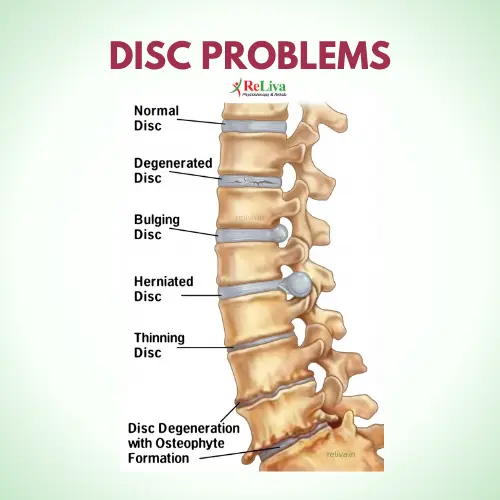
Spine Arthritis vs Disc Problems vs Spondylosis
These three conditions are often confused. Here’s how they differ:
|
Feature |
Spine Arthritis (Facet Joint) |
Disc Problem (Slipped/ Herniated Disc) |
Cervical/ Lumbar Spondylosis |
|---|---|---|---|
|
Structure affected |
Facet joints (posterior spine) |
Intervertebral disc (anterior spine) |
Both discs and joints |
|
Primary symptom |
Local back/neck pain, stiffness |
Radiating pain, nerve symptoms |
Stiffness, aching, possible nerve symptoms |
|
Pain pattern |
Worse with extension, twisting |
Worse with flexion, sitting |
Variable |
|
Morning stiffness |
Common |
Less typical |
Common |
|
Age group |
40+ |
Any age, often 30–50 |
50+ |
|
Imaging finding |
Facet joint narrowing, osteophytes |
Disc protrusion or bulge |
Combined degeneration |
Symptoms of Spine Arthritis
Symptoms vary depending on which part of the spine is affected, but the pattern is usually consistent.
Localised Neck or Lower Back Pain
The most common symptom is a deep, aching pain concentrated in one area of the spine, typically the lower back or the base of the neck. Unlike disc-related pain, it usually doesn’t radiate down the arms or legs unless nerve structures are also irritated.
Pain During Bending, Twisting or Standing
Extension (leaning back) and rotation (twisting) are the movements most likely to provoke pain in facet joint arthritis. Standing for prolonged periods also loads the facet joints and tends to worsen discomfort.
Morning Stiffness or Stiffness After Rest
A characteristic feature of facet joint arthritis is stiffness that’s the worst first thing in the morning or after sitting still for a while. It typically eases within 20–30 minutes of gentle movement.
Reduced Spinal Mobility
Over time, the spine loses its normal range of motion. You may notice you can’t turn your head as far, bend backwards without pain, or twist while driving without discomfort.
Signs the Condition May Be Progressing
Watch for:
- Pain that no longer settles with rest
- Stiffness lasting more than 30 minutes in the morning
- Pain spreading into the buttocks, thighs, or shoulders
- Weakness or pins-and-needles in the arms or legs (suggests nerve involvement, seek assessment promptly)
How Spine Arthritis Affects Daily Activities
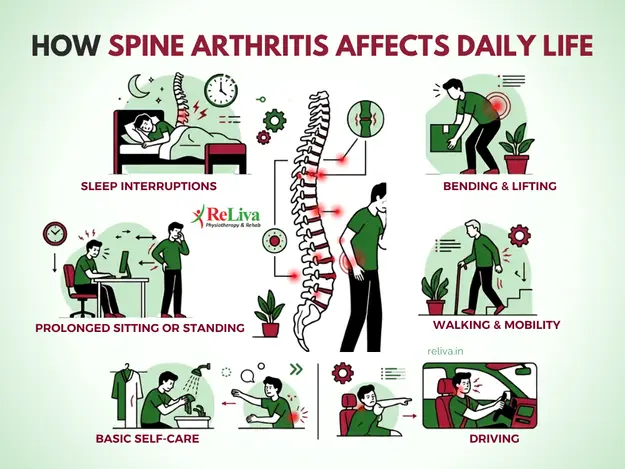
Sitting for Long Periods
Desk workers and frequent travellers often find that prolonged sitting, especially in unsupported chairs, compresses the lumbar facet joints and triggers stiffness or aching by the end of day.
Driving
The combination of a semi-reclined posture, vibration, and limited ability to shift position makes driving particularly uncomfortable. Turning to check blind spots may be painful for those with cervical facet involvement.
Household Activities
Bending to pick things up, reaching overhead, mopping, or carrying laundry can all strain arthritic facet joints. Activities that involve simultaneous bending and twisting are especially provocative.
Walking and Standing
Short walks are generally well-tolerated and beneficial. However, standing in one position for extended periods, especially on hard floors, can aggravate lower back facet joints.
Workstation-Based Jobs
Sustained sitting with a forward-flexed posture places an uneven load on the spine. Without adequate breaks and correct ergonomics, desk-based workers with facet arthritis often experience progressive worsening throughout the working day.
Postural Habits and Ergonomics
Poor postural habits often act as a hidden driver of facet joint pain. Sustained forward head posture puts excessive stress on the cervical facet joints, while chronic lumbar slouching or rounding the lower back while sitting creates asymmetric loading that accelerates joint wear. Ergonomics is the solution to these daily stressors; utilizing lumbar support to maintain the spine’s natural curve, adjusting monitor heights to eye level to prevent neck strain, and ensuring feet are flat on the floor can significantly reduce the mechanical load on the spine, helping to minimize inflammation and discomfort throughout the day.
Causes and Risk Factors
Age-Related Joint Wear and Tear
The most significant risk factor is simply age. After 40, cartilage begins to thin more noticeably, and bone remodelling (including the formation of osteophytes or bone spurs) becomes more common.
Poor Posture and Sedentary Lifestyle
Sustained poor posture, particularly forward head posture or excessive lumbar flexion at a desk creates asymmetric loading on facet joints over years.
Previous Spine Injuries
A history of spinal fracture, whiplash, or any injury that disrupts normal joint mechanics can accelerate cartilage wear in the affected segments.
Repetitive Stress on the Spine
Jobs or sports that involve repeated bending, twisting, heavy lifting, or impact loading place sustained mechanical stress on facet joints, hastening degeneration.
Spine Arthritis vs Other Spine Conditions
Spine arthritis and degenerative disc disease are both common causes of back and neck pain, but they affect different structures within the spine. Understanding the distinction helps ensure appropriate treatment and rehabilitation. Learn more about degenerative disc disease and how it differs from facet joint arthritis.
Spine Arthritis vs Degenerative Disc Disease
|
Spine Arthritis |
Degenerative Disc Disease |
|
|---|---|---|
|
Location of problem |
Facet joints |
Intervertebral discs |
|
Primary complaint |
Stiffness, localised pain |
Aching, possible referred leg pain |
|
Worse with |
Extension, standing |
Prolonged sitting, flexion |
|
Better with |
Rest, gentle movement |
Walking, changing positions |
|
Common finding |
Facet joint narrowing on imaging |
Disc height loss on MRI |
Spine Arthritis vs Cervical Spondylosis
Spine arthritis is often confused with cervical spondylosis, particularly when symptoms involve the neck. While both conditions may cause pain and stiffness, cervical spondylosis is a broader age-related condition that can affect discs, joints, and other spinal structures.
|
Spine Arthritis |
Cervical Spondylosis |
|
|---|---|---|
|
Region |
Any level |
Neck (cervical spine) |
|
What’s affected |
Facet joints primarily |
Discs, facet joints, vertebrae |
|
Symptoms |
Neck or back pain, stiffness |
Neck pain, possible arm symptoms, headaches |
|
Nerve symptoms |
Uncommon unless severe |
More common (cervical radiculopathy) |
Why Accurate Diagnosis Matters
Spine arthritis, disc problems, and spondylosis can all produce similar pain complaints. Treatment differs significantly between them. Treating a disc problem as facet joint arthritis or vice versa, can delay recovery or worsen symptoms. A thorough physiotherapy assessment is the starting point for getting the right care.
How is Spine Arthritis Diagnosed?
Clinical Assessment
Your physiotherapist will take a detailed history of your pain, its location, nature, aggravating factors, and how it affects your daily life. This helps differentiate facet joint pain from disc-related or muscular causes.
Imaging Tests
Imaging may include X-rays (to assess joint space narrowing and osteophytes), MRI (for detailed soft tissue and nerve assessment), and CT scans (for bony detail). Imaging findings are interpreted alongside clinical symptoms, not in isolation.
Movement and Posture Evaluation
This is where physiotherapy assessment adds the most value. Your physiotherapist will evaluate:
- Active range of motion — how far and in which directions your spine can move
- Passive movement testing — identifying which movements provoke or relieve symptoms
- Postural analysis — identifying loading patterns that stress the facet joints
- Muscle strength and activation — particularly core and spinal stabilisers
- Neurological screen — checking reflexes, sensation, and strength to rule out nerve involvement
This comprehensive assessment guides a personalised treatment plan rather than a generic exercise sheet.
Spine Arthritis Treatment Options
Non-Surgical Treatment
The vast majority of people with spine arthritis respond well to non-surgical management:
- Activity modification — identifying and adjusting movements that provoke symptoms
- Pain management — medications, heat/cold therapy, or electrotherapy as appropriate
- Weight management — reducing spinal load significantly eases facet joint compression
- Lifestyle correction — improving sleep posture, daily movement habits, and ergonomics
- Physiotherapy for Spine Arthritis – Physiotherapy is the most evidence-supported treatment for facet joint arthritis. It addresses pain, mobility, strength, and long-term self-management, not just short-term symptom relief.
Spine Arthritis – When is Surgery Needed?
Surgery is considered only when:
- Symptoms are severe and unresponsive to conservative treatment for several months
- There are significant functional limitations affecting quality of life
- Nerve involvement is confirmed (e.g. progressive weakness, significant radiculopathy)
For the overwhelming majority of patients, well-directed physiotherapy and lifestyle changes are sufficient.
When surgery becomes necessary, structured post operative physiotherapy plays an important role in restoring mobility, strength, and function.
Physiotherapy for Spine Arthritis
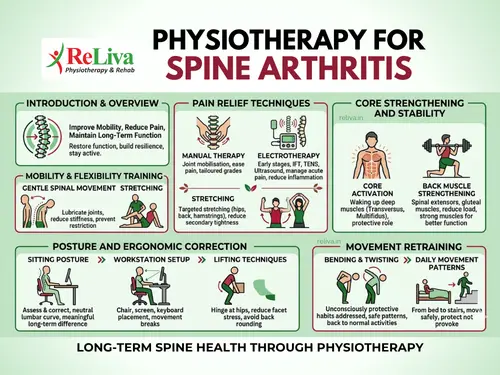
Like other forms of physiotherapy for arthritis, treatment focuses on improving mobility, reducing pain, and maintaining long-term function. This is the most important part of your treatment. Physiotherapy doesn’t just reduce pain, it restores function, builds resilience, and helps you stay active long-term.
Check this real comment from real experience of spine arthritis treatment in electronic City, Bangalore at ReLiva Physiotherapy clinic – “I visited the clinic for lower back pain and I am really happy with the care I received. Physiotherapist Dr. Gayathri was professional and attentive. I noticed improvement within a few sessions. She explained about the core spine strengthening exercises. Highly recommended,” comments Vini Mary.
Pain Relief Techniques
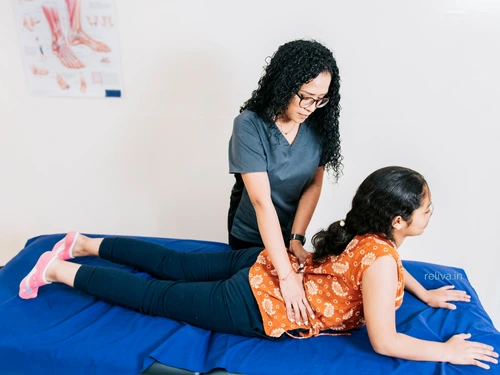
Manual Therapy Hands-on mobilisation of the facet joints by a trained physiotherapist helps restore joint movement, reduce stiffness, and ease pain. Techniques are graded in intensity and tailored to what each patient can tolerate. Learn more about manual therapy for arthritis and how hands-on techniques can improve joint mobility and reduce stiffness.
Electrotherapy Modalities such as IFT (Interferential Therapy), TENS, and ultrasound are used in the early stages to manage acute pain and reduce local inflammation, making movement and exercise more accessible.
Heat packs are used to relax muscles and improve circulation before movement, while ice reduces acute swelling and inflammation during flare-ups.
Mobility and Flexibility Training
Gentle Spinal Movement: Controlled movements that take the spine through its available range help lubricate joints, reduce stiffness, and prevent further restriction. These are progressed carefully as tolerance improves.
Stretching: Targeted stretching of the hip flexors, thoracic spine, hamstrings, and paraspinal muscles reduces the secondary muscle tightness that often accompanies facet joint arthritis.
Core Strengthening and Stability
Core Activation The deep stabilising muscles of the spine, particularly the transversus abdominis and multifidus, are frequently inhibited in those with chronic back pain. Physiotherapy uses specific activation exercises to wake these muscles up and restore their protective role.
Back Muscle Strengthening Progressive strengthening of the spinal extensors, gluteal muscles, and hip stabilisers reduces the load placed on arthritic facet joints during daily movement.
Research consistently shows that stronger spinal stabilising muscles help reduce pain and improve function in people with chronic spine arthritis.
Posture and Ergonomic Correction
Sitting Posture: Your physiotherapist will assess how you sit and teach you to maintain a neutral lumbar curve, neither excessively arched nor slumped. Even small corrections consistently applied make a meaningful long-term difference.
Workstation Setup Guidance on chair height, screen position, keyboard placement, and regular movement breaks is tailored to your specific work setup.
Lifting Techniques Learning to hinge at the hips rather than rounding the lower back dramatically reduces facet joint stress during everyday lifting.
Movement Retraining
Bending and twisting, many people unconsciously adopt movement patterns that protect painful joints in the short term but create compensatory strain elsewhere. Physiotherapy retrains safe, efficient movement patterns for bending, twisting, and reaching, so you can get back to normal activities with confidence.
Daily Movement Patterns, from getting out of bed to climbing stairs to reaching into a cupboard, your physiotherapist helps you move through daily life in ways that protect rather than provoke your spine.
Struggling with Persistent Neck or Back Stiffness?
Facet joint arthritis often responds well to early physiotherapy. A personalized assessment can help identify the movements, postures, and daily activities contributing to your symptoms and create a treatment plan focused on reducing pain, improving mobility, and restoring confidence in movement.
Best Exercises for Spine Arthritis
These exercises complement your physiotherapy sessions. Always perform them within a pain-free range and consult your physiotherapist before starting if you’re newly diagnosed.
Mobility Exercises
Cat-Cow Stretch On hands and knees, gently alternate between arching and rounding the back. Lubricates the spinal joints and reduces morning stiffness. 8–10 slow repetitions.
Pelvic Tilts: Lying on your back with knees bent, gently flatten your lower back to the floor, then restore the natural arch. Activates deep spinal stabilisers and improves lumbar mobility.
Strengthening Exercises
Core Stabilisation Exercises, such as dead bugs, bird dogs, and modified planks, build endurance in the deep core muscles that protect the facet joints during activity. Form matters more than intensity.
Low Impact Activities
Walking — Regular, gentle walking maintains spinal mobility, supports weight management, and has an anti-inflammatory effect. Start with 15–20 minutes daily and build gradually.
Swimming — The buoyancy of water reduces spinal load while allowing a full range of movement. Backstroke and gentle freestyle are well-tolerated by most people with facet arthritis.
For additional guidance, explore these arthritis exercises to reduce pain designed to improve mobility and joint function.
Daily Tips to Manage Spine Arthritis
Avoid Prolonged Sitting
Set a reminder to get up and move every 30–40 minutes. Even a short walk to the water cooler or a brief standing stretch makes a difference.
Maintain Neutral Spine Posture
Whether sitting, standing, or walking, aim to maintain the natural S-curve of your spine, not excessively arched, not slumped forward.
Use Ergonomic Support
A lumbar roll in your car or office chair helps maintain the natural lumbar curve. Choose a supportive mattress and sleep in positions that don’t strain the spine (side-lying with a pillow between the knees works well for most).
Stay Active with Safe Movement
The instinct to rest and avoid movement when you have arthritis is understandable, but movement is medicine. Low-impact activity keeps the joints lubricated, the muscles supportive, and the pain more manageable.
When to See a Physiotherapist for Spinal Arthritis?
Persistent Back or Neck Pain
Pain that has lasted more than two to three weeks without clear improvement deserves a professional assessment, not just rest and hope.
Reduced Mobility
If you’ve noticed your spine moving less freely, difficulty turning your head, restricted bending, or reduced walking tolerance, physiotherapy can help reverse this before it becomes entrenched.
Pain Affecting Daily Activities
If spine arthritis is limiting your work, sleep, household activities, or social life, it’s time to see a physiotherapist.
Struggling with persistent neck or back stiffness?
If pain, reduced mobility, or difficulty performing everyday activities is affecting your quality of life, a physiotherapy assessment can help identify whether facet joint arthritis is contributing to your symptoms and create a personalised treatment plan.
ReLiva Physiotherapy has clinics across Mumbai, Pune, Delhi, and other major cities, with experienced physiotherapists who specialise in spinal conditions.
Can Spine Arthritis Be Managed Without Surgery?
Yes — for the vast majority of people, absolutely.
Physiotherapy, targeted exercise, postural correction, and lifestyle modification form a highly effective long-term management strategy for spine arthritis. Surgery is reserved for a small minority with severe nerve involvement or functional limitation unresponsive to conservative care. Most patients who engage consistently with physiotherapy see meaningful improvement in pain levels, mobility, and daily function, without going under the knife.
What is the Best Physiotherapy for Spine Arthritis?
The best physiotherapy for spine arthritis uses a comprehensive, multimodal approach. Treatment focuses on manual therapy to reduce joint stiffness and alleviate pain, combined with posture correction to relieve spinal pressure. Furthermore, targeted strengthening exercises stabilize the core, while mobility drills improve range of motion, ensuring long-term functional independence and reduced discomfort.

Frequently Asked Questions About Spine Arthritis
Q. What is the best treatment for spine arthritis?
Ans. Physiotherapy is one of the most effective treatments for spine arthritis. It combines manual therapy, targeted exercises, posture correction, and movement retraining to reduce pain, improve mobility, and support long-term spinal health.
Q. Is walking good for spine arthritis?
Ans. Yes. Regular, gentle walking is one of the best things you can do for spine arthritis. It keeps joints mobile, supports healthy weight, and has a natural anti-inflammatory effect. Start with 15–20 minutes daily on even ground and build up gradually.
Q. How is facet joint arthritis treated?
Ans. Treatment typically includes physiotherapy (manual therapy, exercise, posture correction), pain management (anti-inflammatories, heat therapy), activity modification, and lifestyle changes. In more severe cases, facet joint injections may be used alongside physiotherapy. Surgery is rarely required.
Q. Can physiotherapy reduce back arthritis pain?
Ans. Yes. At ReLiva Physiotherapy & Rehab, therapists directly address the key drivers of pain in spine arthritis, joint stiffness, muscle weakness, poor posture, and inefficient movement patterns. Most patients experience a significant reduction in pain and improvement in function within several weeks of starting treatment.
Q. Can spine arthritis get worse if left untreated?
Ans. Yes. Without appropriate management, facet joint arthritis can progress, leading to greater stiffness, reduced mobility, and in some cases, the development of bone spurs that impinge on nerve roots. Early physiotherapy intervention slows this progression and helps maintain function.
Q. What is the difference between spine arthritis and a slipped disc?
Ans. Spine arthritis primarily affects the rear facet joints, leading to localized stiffness and pain during activities like twisting or bending backward. In contrast, a slipped disc involves the front intervertebral disc, often causing radiating pain into the limbs. As both conditions can occur together, an accurate diagnosis is vital for treatment.
Q. Is spine arthritis the same as spondylosis?
Ans. Yes, they are essentially the same. “Spine arthritis” is a general term often used by patients, while spondylosis is the medical term for age-related degeneration of the spinal discs and joints. Both refer to the wear-and-tear process that leads to stiffness and discomfort.
Don’t Let Spine Arthritis Limit Your Everyday Life
Persistent neck or back pain, stiffness, and reduced mobility are not simply a normal part of ageing. With the right physiotherapy approach, many people with spine arthritis can stay active, manage symptoms effectively, and avoid surgery. Speak with a ReLiva physiotherapist to begin a personalised spine arthritis treatment plan focused on long-term pain relief and better movement.
……….
This article has been reviewed by physiotherapist Hetvi Shah. Dr Hetvi (PT) is a very senior and highly qualified physiotherapist in Vadodara. She effectively diagnoses and treats neurological conditions such as spinal cord injury, stroke, traumatic brain injury, multiple sclerosis, Parkinson’s disease, and cerebral palsy. Skilled in advanced physiotherapy techniques like PNF and NDT, she excels in rehabilitation post neuro surgery. Dr. Shah also leads the Reliva team in providing women’s health physiotherapy in Vadodara, including prenatal and postnatal care, Diastasis Recti, urinary incontinence, pelvic floor therapy, and pregnancy yoga.
….